

Dual-Purpose vs. Separate Rigs: How the CMR1000A Solves the Remote Exploration Logistics Nightmare
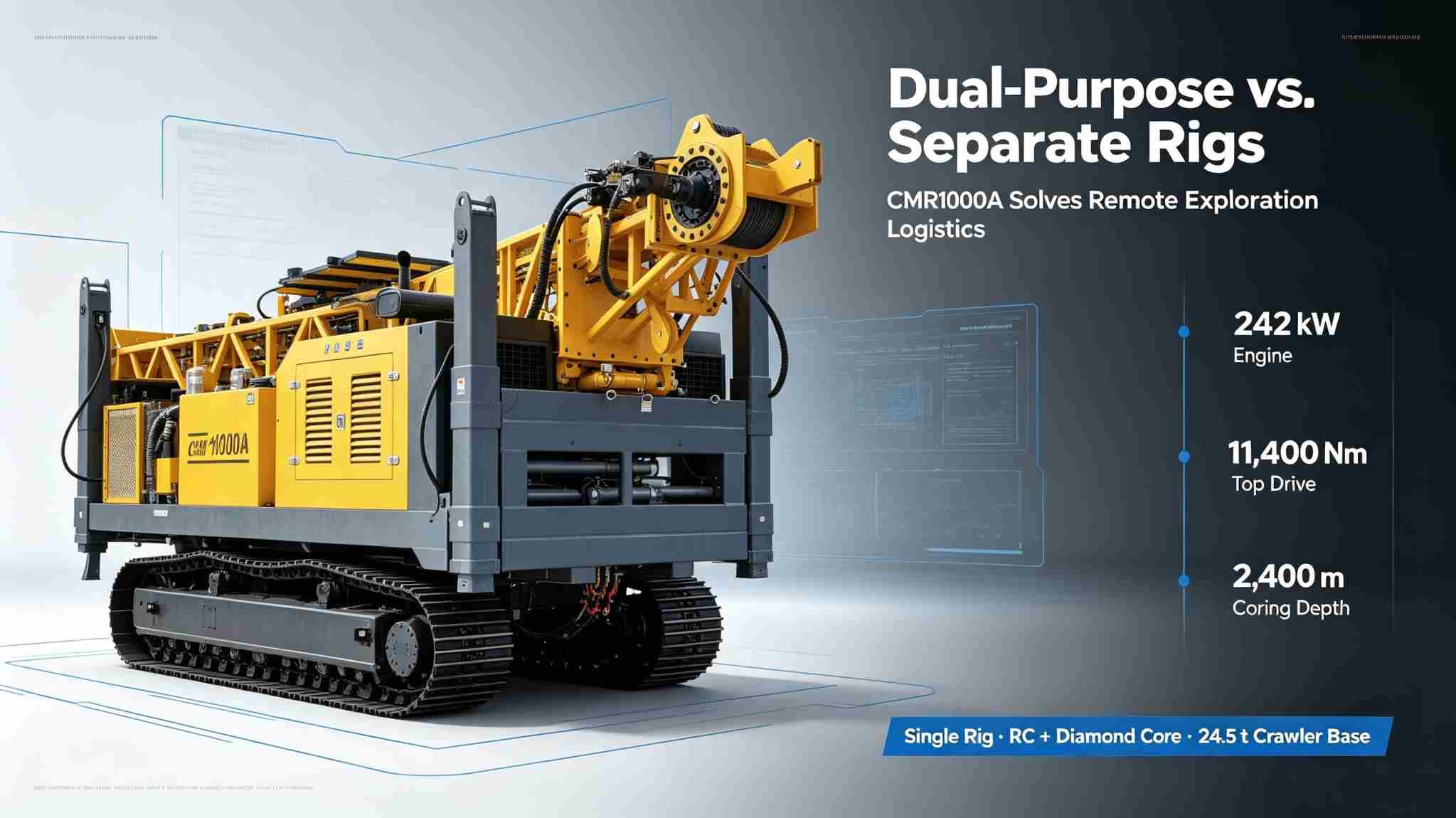
If you frequent mineral exploration forums like r/mining or r/Geotech, you will inevitably run into the classic logistical debate: Should you mobilize separate Reverse Circulation (RC) and Diamond Core rigs for a remote exploration project, or should you deploy a single multi-functional dual-purpose rig?
For project managers operating in remote terrains—such as the expansive steppes of Central Asia, the deserts of Africa, or the rugged outbacks of Australia—this isn’t just a technical query; it’s a million-dollar logistical equation. Mobilizing multiple heavy vehicles across thousands of kilometers of unpaved terrain drastically inflates the project’s carbon footprint, camp overheads, and supply chain risks.
However, many geologists remain skeptical of hybrid rigs, asking: “Can a single combination rig actually deliver the high-RPM speed required for deep diamond coring while maintaining the high-torque, heavy-hoist capability needed for rugged RC drilling?”
Today, we will analyze the engineering and technical specifications of the CORTECH CMR1000A Multi-Functional Combination Drilling Rig to see how modern heavy machinery engineering has officially tipped the scales in favor of the dual-purpose strategy.
The Mobilization Nightmare: Counting the Real Cost of Fleet Logistics
In greenfield exploration, the standard workflow requires drilling through hundreds of meters of barren, highly weathered overburden before hitting the solid bedrock containing the target mineralization.- The Traditional Approach: Project managers deploy an air RC rig to rapidly hammer through the gravel, sand, or clay layer and collect chips for initial geochem assaying. Once they hit the hard target stratum, they stand down the RC team and mobilize a dedicated diamond coring rig to extract intact cylinders of rock.
- The Operational Bottleneck: This double-mobilization strategy means paying for twice the freight, managing two separate heavy-duty diesel drive trains, and doubling the spare parts inventory (two sets of hydraulic seals, different engine filters, and distinct mast components) in a camp that might be a twelve-hour helicopter ride from the nearest town.
Power Architecture: The Heart of the Dual-Purpose Capability
The primary reason early-generation hybrid rigs failed on site was under-powered hydraulic systems. Diamond coring requires high rotational speeds (RPM) with precise feed pressure control, while RC drilling demands brutal torque and exceptional lifting capacity to manage heavy dual-wall drill strings.The CMR1000A solves this bottleneck through a heavy-duty power plant and premium hydraulic layout:
- Engine & System Pressure: Driven by a high-performance Cummins L8.9CS4 330C Turbocharged Engine rated at 242 kW (2,200 rpm), the rig channels massive power into a specialized 29 MPa hydraulic system.
- Top-Drive Rotation Head: Unlike old mechanical rotary tables, the top-drive design of the CMR1000A delivers a maximum torque of 11,400 Nm for breaking tough formations during RC or tricone operations, yet it can seamlessly shift gears to reach a high speed of 1,180 rpm for efficient diamond wireline cutting.
- Cooling System: Utilizing an advanced air-cooling module, the hydraulic system resists fluid degradation even when operating under continuous high-load RC hammering in arid, water-scarce desert conditions.
Deep-Hole Capacity: No Compromises on Core Target Depth
Another common critique on Reddit is that multi-functional rigs are "jack of all trades, master of none," particularly when it comes to deep-hole coring limits. Let’s look directly at the certified capacity matrix of the CMR1000A:
| Drilling Method | Drill Rod Diameter / Specification | Maximum Depth Capability |
|---|---|---|
| Air Reverse Circulation (RC) | 4.0” Drill Rods | 400 meters |
| Air Reverse Circulation (RC) | 4.5” Drill Rods | 320 meters |
| Diamond Wireline Coring | P‑Size (114mm) | 1,100 meters |
| Diamond Wireline Coring | H‑Size (89mm) | 1,600 meters |
| Diamond Wireline Coring | N‑Size (71mm) | 2,400 meters |
| Diamond Wireline Coring | B‑Size (55.5mm) | 3,000 meters |
Supporting this deep-hole capacity is a rugged mast setup featuring a 7,320 mm feed stroke and a main winch offering a massive lifting force of 191 kN at 30m/min. More importantly, the auxiliary winch features an impressive wire rope capacity of 2,500 meters, removing the need for third-party aftermarket winch extensions when retrieving wireline core inner tubes from ultra-deep target zones.
Smart Structural Engineering for Tough Terrains
A dual-purpose rig is useless if the drill crew spends half their day wrestling with heavy tools during a process changeover.The CMR1000A incorporates a multi-rod compatible aperture foot clamp (Chuck) supporting B, N, H, P, and PW rods, alongside an integrated hydraulic breakout clamp (Clamp Unloader) calibrated for 3.5”, 4任务, and 4.5” rods. When transitioning from a 4-inch RC overburden pre-collar to an H-size wireline core hole, the crew does not need to manually swap out the primary breakout jaw assemblies. The hydraulic system self-adjusts, drastically reducing operational downtime and lowering the risk of manual handling injuries on the rig floor.
Furthermore, with a 1,400 mm mast slide stroke and the ability to drill angled structural holes from 45° to 90°, the rig provides the precise structural flexibility needed to map out complex geological formations, faults, and dipping orebodies without moving the crawler base.
Conclusion: The Bottom Line for Project Managers
When evaluating exploration logistics, the question shouldn't just be “what is the cost per meter?” but rather “what is the cost of total project execution?”By eliminating the necessity for a secondary rig mobilization, reducing the diesel engine maintenance footprint by 50%, and offering uncompromised deep coring depths down to 3,000 meters, the CMR1000A Multi-Functional Drilling Rig transforms remote exploration from a logistical nightmare into a streamlined, high-efficiency operation.