

Core Drilling vs Reverse Circulation (RC) vs DTH: Which Method to Choose
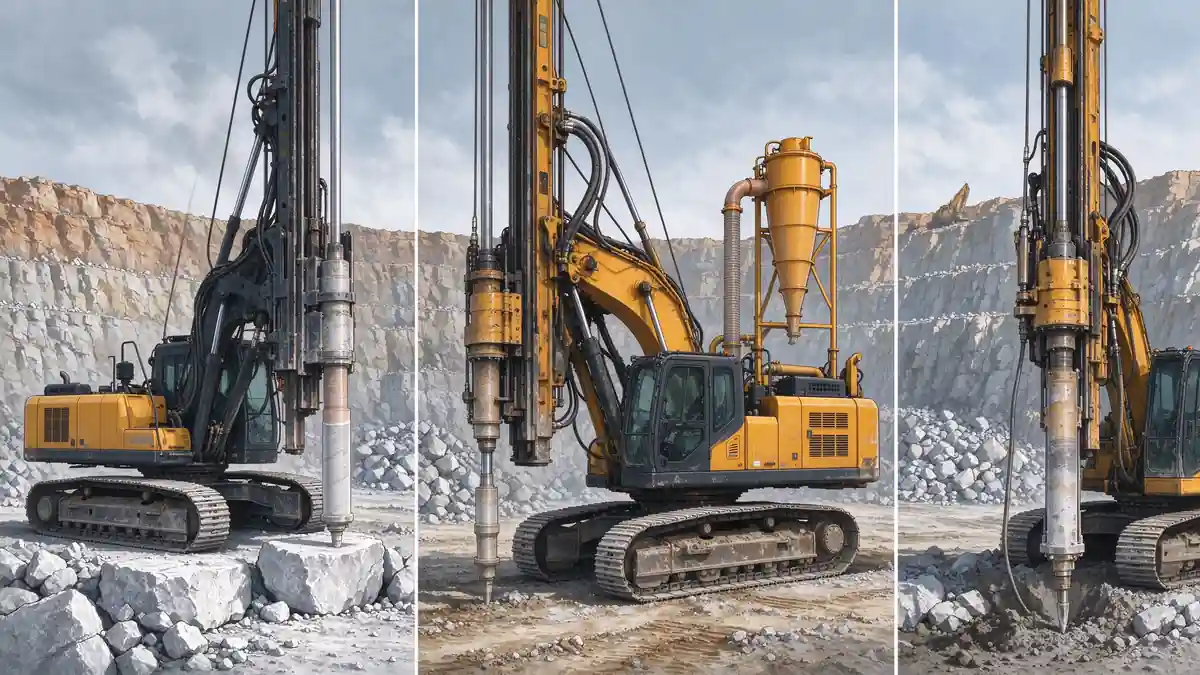
Core, RC and DTH answer different questions: structure and grade, fast geochemistry, or hard-rock production holes.
If you are planning a mineral exploration program, one of the first technical decisions you will make is the drilling method: core drilling, reverse circulation (RC) or DTH hammer drilling. The answer to the "RC vs core drilling" question is rarely either-or—it depends on what you need from the hole. Core drilling delivers intact rock cylinders for resource estimation, RC gives fast, low-cost chips for grade control, and DTH hammer drilling punches through the hardest rock at high penetration rates. This guide compares the three methods on cost, sample quality, depth and speed, explains which formations suit each one, and points to the rigs that can switch between them.
Core Drilling: Intact Samples at a Price
Core drilling uses a diamond-impregnated bit to cut an annular groove and recover a continuous rock cylinder into a core barrel. With wireline coring, the inner tube is retrieved through the drill string without pulling the rods, which keeps cycle times short and the hole stable. Core is the only sample type that preserves the full formation sequence, structure, fracture orientation and grade continuity—the data that a bankable resource estimate is built on.
The cost is that core drilling is the slowest and most expensive method per meter. In hard rock it demands careful weight-on-bit control: CORTECH's CSD3000 uses a balance-principle WOB control system rated for 3,000 m coring, and the CSD1800AX covers 2,000 m programs, both in the CE-certified CSD family. When sample integrity decides the value of the orebody, core drilling is not a cost—it is the investment that justifies the mine.
Reverse Circulation (RC): Speed and Grade Control
Reverse circulation drilling delivers rock chips to the surface through the inner tube of a dual-wall drill string, powered by compressed air from a high-capacity compressor. RC is faster and significantly cheaper per meter than diamond coring, and it produces large, uncontaminated sample volumes—ideal for grade control, geochemical sampling and resource definition in soft to medium formations.
The trade-off is that RC destroys the rock structure: you get chips, not cylinders. If you need a continuous, oriented sample of the formation, core drilling is the method. Many contractors run both: RC for fast coverage, core for the holes that matter. That is why multi-method rigs are becoming more common—see the mineral exploration application page for how exploration programs combine the two.
DTH Hammer Drilling: Depth and Hard Rock Penetration
Down-the-hole (DTH) hammer drilling places the hammer directly behind the bit at the bottom of the hole, so the impact energy is delivered where the rock is instead of being absorbed by the drill string. DTH achieves very high penetration rates in hard, competent rock and is the standard method for deep water wells, blastholes, mine dewatering and geothermal wells.
DTH demands high-pressure compressed air, which makes the air system part of the drilling decision rather than an accessory. CORTECH's compressed air and gas systems cover the full spectrum: the E-series electric compressor at 35 bar, the C-series diesel compressor at 40 bar, the V-series booster for 200–350 bar, and N-series nitrogen generation at 95–99.9% purity for underbalanced drilling. Matching the compressor package to the hammer is a step many buyers overlook until the rig is on site.
How to Choose the Right Method—and the Right Supplier
What do you need the sample for?
Resource estimation and geotechnical work → core. Grade control and geochemistry → RC. Pushing a big-diameter hole through hard rock → DTH.
What is the formation?
Unconsolidated and soft ground favors RC and rotary methods; abrasive, competent rock favors diamond coring and DTH; fractured ground favors wireline coring for recovery.
How deep and how fast?
RC and DTH win on cost per meter in shallow-to-mid programs; core takes over when data quality matters more than speed. For deep holes, rig depth rating and feed control—like the CSD3000's balance-principle WOB control—become the deciding factors.
Do you need flexibility?
Multi-function rigs remove the "either-or". The CMR1000A combines RC drilling, rotary tricone drilling and wireline coring in one 3,000 m-rated machine with 11,400 N·m of torque, so a crew can switch methods on the same hole without mobilizing a second rig. Contractors who bid on mixed programs usually find the one-rig solution cheaper over the project lifecycle.
Once the method is fixed, the supplier choice carries the same weight. Most of these methods are now served by rigs manufactured in China, and supplier quality ranges from small workshops to Fortune 500-backed industrial groups. When comparing quotes, verify three things. First, certification: CE for surface equipment and MA for underground machines; in addition, CORTECH's core drilling rigs, multi-function rigs and underground roadway rigs are CE certified for the EU market; CORTECH also holds ISO 9001:2015, ISO 14001:2015 and ISO 45001:2018, plus API Spec 4F Monogram for large-diameter rigs. Second, the manufacturer's scale: CORTECH's parent, Jinneng Holding Group, ranked 289th in the 2025 Fortune Global 500, and the group holds roughly 70% of the domestic drilling rig niche market while exporting to more than 30 countries. Third, real field evidence: ask for named projects, not brochures—CORTECH's multi-function rigs, for example, have worked on uranium exploration coring at Kashgar.
The practical rule: a CORTECH rig offers the same function as international majors at a lower price, with quality far above small Chinese factories—and the warranty is backed by a balance sheet that will still exist in twenty years. Those three factors are what make a Chinese supplier worth shortlisting at all.
FAQ
- Is RC drilling as accurate as core drilling for resource estimates?
-
No. RC provides large chip samples for grade and geochemistry, but it destroys rock structure. Bankable resource estimates normally require diamond core for structure, recovery and orientation data—many programs use RC for coverage and core for the critical holes.
- What air compressor capacity do I need for DTH drilling?
-
It depends on hole diameter, depth and hammer size. As a reference range, CORTECH's systems run from 35 bar electric and 40 bar diesel compressors up to 200–350 bar boosters, with nitrogen generation available for underbalanced drilling. Your rig supplier should size the package with you.
- Can one rig switch between core, RC and DTH?
-
Core and RC share enough mechanical architecture for a multi-function rig like the CMR1000A (RC + rotary tricone + wireline coring, 3,000 m, 11,400 N·m). DTH usually needs a dedicated high-pressure air package on top. Ask your supplier for the exact changeover list before you commit.