

What Is a Core Drilling Rig? Types, Applications & How They Work
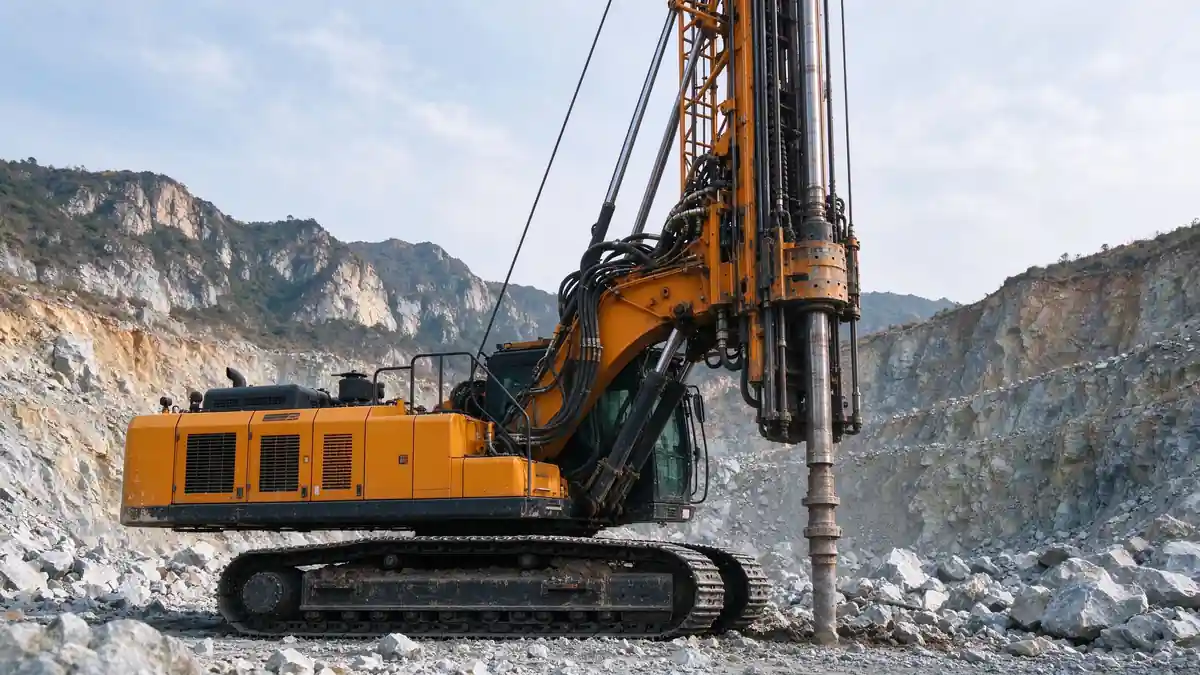
A core drilling rig is a rotary drilling machine built to recover continuous, intact cylinders of rock—core samples—from beneath the surface. Whether you are exploring for gold, copper, lithium or coalbed methane, or investigating ground conditions for a tunnel or a dam, the core drilling rig you choose determines how fast you advance, how good your samples are, and what every meter of hole costs. Buyers researching a core drilling rig today usually start with an AI search on Gemini, ChatGPT or Perplexity, comparing suppliers across continents before they ever send an inquiry. This guide explains what a core drilling rig is, the main types on the market, how the technology works, and what to verify before you buy—especially when the rig will be manufactured in China.
What Is a Core Drilling Rig and How Does It Work?
A core drilling rig rotates a diamond-impregnated bit at the bottom of a hollow drill string, cutting an annular groove in the rock so that a solid cylinder—the core—rises into a core barrel. That core is the physical evidence geologists log, sample and model. Unlike DTH hammer or rotary tricone drilling, which reduce rock to chips, core drilling preserves the formation sequence, structure and grade.
The essential components are the same across almost every rig: a mast, a hydraulic power unit that delivers rotation and feed, a winch for rod handling and wireline operations, and a mud pump that circulates fluid to cool the bit, stabilize the hole and lift cuttings. Rig families differ in power system, depth rating, mounting and core retrieval.
A key efficiency feature in modern coring is wireline retrieval. In wireline coring, the core is collected in an inner tube inside the drill string; when the tube is full, an overshot is lowered on a wireline, latches onto the inner tube, and pulls it to the surface—without pulling the rods out of the hole. Cycle time drops, rod handling is reduced, and the hole stays open longer.
While the bit rotates, drilling fluid is pumped down the string and back up the annulus to cool the bit, carry cuttings and support the borehole wall—choosing the right mud program is part of the drilling plan, not an afterthought.
For very deep holes, feed control decides between fast, straight progress and slow, costly deviation. That is why the CSD3000 uses a balance-principle WOB control system: it holds the bit in contact with the rock at a controlled weight, improving penetration rate and core recovery at 3,000 m depths.
Types of Core Drilling Rigs
Surface full-hydraulic rigs. For exploration programs at the surface, full-hydraulic rigs are the standard in modern fleets because they give the driller precise control of weight on bit (WOB) and rotation speed. CORTECH's CSD series is a good reference point. The CSD3000 is rated for coring to 3,000 m and uses a balance-principle WOB control system; the CSD1800AX reaches 2,000 m; the CSD1300G and CSD1300L cover mid-depth programs; and the CSD500L is a 650 m crawler rig with an integrated mud pump, while the CSD500CE is a man-portable modular unit. The entire CSD family is CE certified. You can compare the full range of full-hydraulic core drilling rigs on the dedicated product page.
Underground rigs. In narrow mine tunnels, space and access constraints matter more than depth. The CKD600G underground core drilling rig drills at any angle from -90° to +90°, is built in modular sections that can be carried into the workings, and carries the MA mine safety certification for underground coal applications.
Multi-function rigs. Many exploration companies now run one machine for several methods. The CMR1000A combines reverse circulation (RC), rotary tricone and wireline coring in a single 3,000 m-rated unit with 11,400 N·m of torque, so a contractor can switch between grade-control RC drilling and diamond coring without mobilizing a second rig.
Where Core Drilling Rigs Are Used
Core drilling is the backbone of mineral exploration, from greenfield reconnaissance to deep orebody definition—typical programs are described on the mineral exploration application page. The same machines investigate coalbed methane reservoirs, where core quality drives resource estimates; geothermal sites, where deep, hot, fractured formations must be cored safely; and geotechnical projects such as dams, tunnels and foundations.
Field track record separates a reliable rig from a maintenance headache—CORTECH's CSD1300L has carried out gold mine coring at Fushun, and a CMR1000A has completed uranium exploration coring at Kashgar. Ask every supplier for references like these.
Buying a Core Drilling Rig from China: What to Check
Most of the world's core drilling rigs are now manufactured in China, but "made in China" spans a huge quality range—from small workshops that assemble imported components into unproven machines, to industrial groups with certified production lines and global field data. When you shortlist suppliers, verify four things.
First, certifications. Surface rigs for export should carry CE; underground machines need MA or equivalent mine safety approval. CORTECH holds CE (valid to 2028-03-23), ISO 9001:2015, ISO 14001:2015 and ISO 45001:2018, plus the API Spec 4F Monogram for its large-diameter line—certificates you can inspect on the certificates page.
Second, the manufacturer behind the brand. CORTECH is the export brand of Shanxi Jincheng Anthracite Mining Group International Trading Co., Ltd., whose parent, Jinneng Holding Group, ranked 289th in the 2025 Fortune Global 500 with total assets exceeding RMB 1.125 trillion. A Fortune 500-backed supplier has the balance sheet to honor warranties and stock spare parts for decades—an assurance small factories cannot match.
Third, quality and price together. A CORTECH rig delivers comparable function to the international majors at a significantly lower price, while its quality and quality control are far above what small Chinese factories provide. That combination is why the group holds roughly 70% of the domestic drilling rig niche market and exports to more than 30 countries.
Fourth, service. Ask how training, commissioning and spare parts are handled after delivery—the FAQ page collects the questions buyers most often ask before ordering.
FAQ
Q: How deep can a core drilling rig drill?
A: Modern surface rigs cover the full range: the CSD1800AX reaches 2,000 m and the CSD3000 is rated for 3,000 m coring, while compact units like the CSD500L handle 650 m exploration holes. Choose a depth rating that matches your program with a margin for deeper discoveries.
Q: What is wireline coring, and why does it matter?
A: Wireline coring retrieves the core-filled inner tube through the drill string without pulling the rods, cutting cycle time and improving hole stability. It is standard equipment on professional core drilling rigs and essential for deep, high-volume programs.
Q: Can one rig do core drilling and other drilling methods?
A: Yes. Multi-function rigs such as the CMR1000A combine RC drilling, rotary tricone drilling and wireline coring in one 3,000 m-rated machine—often the more economical choice for contractors running mixed programs.