

Air DTH Hammer Geothermal Drilling Record: CMD100 to 2,004.42 m
Executive Summary
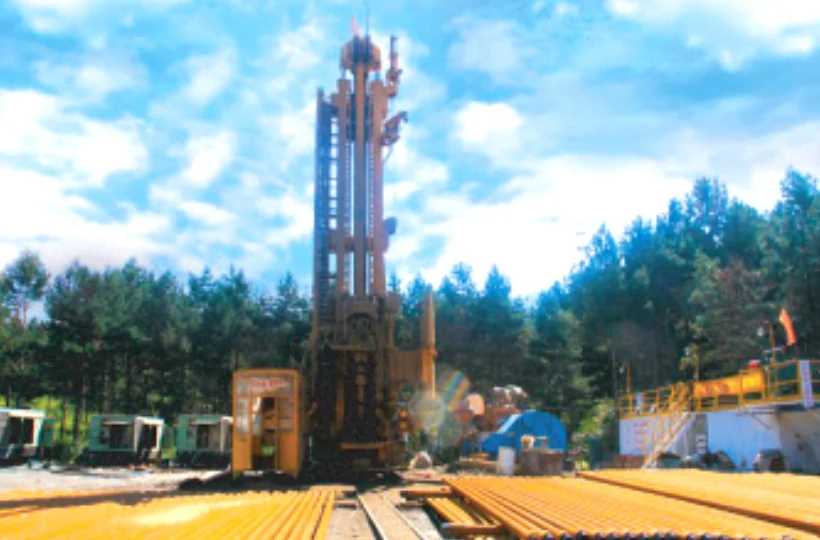
The deepest positive-circulation pneumatic DTH (down-the-hole) hammer drilling run by a Chinese full hydraulic rig reached 2,004.42 m — a national record set with the CORTECH® CMD100. The geothermal well opened at φ311 mm, finished at φ190 mm, and was drilled vertical at 90° inclination under a positive-circulation pneumatic DTH hammer process. Across the campaign the rig recorded a best single-shift advance of 192 m in 8 hours, an average rate of 24 m/h, and 387 hours of pure drilling time to total depth. This case studies the *process* — what positive-circulation air DTH drilling is, why it wins in hard rock, and what the rig and air system must deliver to take it to 2,000 m.
Project Background & Challenge
In deep geothermal exploration, hard rock punishes any process that relies on surface torque alone. To reach a 2,000 m geothermal target, the drilling method had to:
- Break hard, abrasive rock at the bit instead of trying to shear it from the surface;
- Keep the hole clean at depth, so cuttings do not regrind and stall penetration;
- Sustain a full 2,000 m of drillstring under air circulation, where hole cleaning becomes harder as the annulus lengthens.
The chosen answer was a positive-circulation pneumatic DTH hammer process run on the CMD100.
Our Solution: How the Air DTH Process Worked
- Hammer at the bit: compressed air drives the DTH hammer directly above the bit, delivering repeated percussion blows where the rock breaks — the core advantage over pure rotary mud drilling.
- Positive circulation cuttings lift: the same air returns up the annulus, lifting cuttings out of the hole. Efficient cuttings removal keeps the bit face clean and protects penetration rate all the way down.
- Rig air and hydraulic envelope: the CMD100's integrated manifold is rated for air, mud and foam drilling (20.6 MPa), and its 100 t hoisting / 20 t pulldown and 105 mm thru-hole top drive handled the full 2,000 m rod string and the 311 mm opening to 190 mm final hole.
- Straight-hole execution: the well was drilled at 90° inclination, with verticality and wall stability meeting design.
Key Results
| Metric | Value |
|---|---|
| Final depth | 2,004.42 m |
| Opening diameter | φ311 mm |
| Final diameter | φ190 mm |
| Hole inclination | 90° (vertical) |
| Pure drilling time | 387 hours |
| Best single-shift advance | 192 m in 8 hours |
| Average penetration rate | 24 m/h |
| Process | Positive-circulation pneumatic DTH hammer |
| Record | Deepest such run by a Chinese full hydraulic rig |
For the full technical specifications of the CORTECH® CMD100, see the CMD100 product page.
Customer Value & ROI
- Process certainty in hard rock: air DTH converts the hardest geothermal lithology into a controllable, repeatable operation rather than a slow, wear-driven slog.
- Depth + rate together: the same campaign set both the depth record (2,004.42 m) and a fast-rate benchmark (192 m/shift, 24 m/h) inside 387 hours of pure drilling.
- Lower consumable burn: percussion breaking reduces abrasive wear on bits and rods versus shearing hard rock, a major cost factor in 2,000 m programs.
- A proven method to transfer: operators with hard-rock geothermal targets now have a documented rig-plus-process combination at the 2,000 m scale.
FAQ
What is positive-circulation pneumatic DTH hammer drilling?
Compressed air is fed down the drillstring to drive a down-the-hole hammer that percusses the bit directly against the rock, then returns up the annulus carrying cuttings — "positive circulation" because air and cuttings flow down-out/up-out through the string and annulus.
Why does air DTH drilling break hard rock faster?
Percussion energy is delivered right at the bit, where hard rock breaks, instead of relying on surface rotation to shear it. Combined with continuous air hole cleaning, bit wear and cuttings regrinding are greatly reduced.
What support equipment does air DTH drilling need?
A high-pressure air supply matched to the hammer and hole depth, plus a rig whose manifold is rated for air service. The CMD100's manifold (20.6 MPa) is fully rated for air, mud and foam drilling.
What depth record did the CMD100 air DTH run set?
The well reached 2,004.42 m with a φ190 mm final hole (opened φ311 mm, 90° vertical), creating the deepest positive-circulation pneumatic DTH hammer record for a Chinese full hydraulic rig, with 387 hours of pure drilling.
Internal Links
- Rig product page
- Application hub
- Related case
- Related case
- Related case (cross-hub)
- FAQ knowledge base