

Deep Geothermal Well Drilling Rig: CMD180T Four-Spud Well to 3,780 m
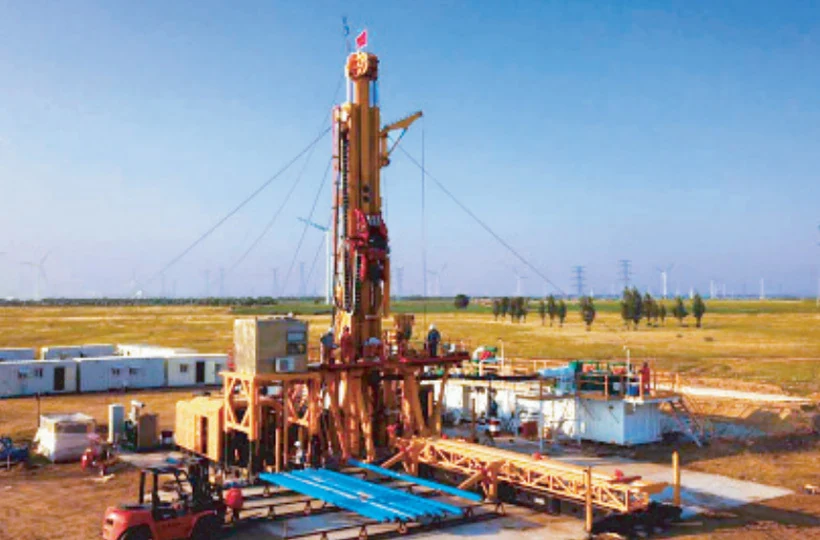
CORTECH CMD180T deep geothermal well drilling rig completing a four-spud well to 3,780 m
Executive Summary
A deep geothermal production well was completed to 3,780 m with the CORTECH® CMD180T modular deep-well rig, drilling a four-spud (four-section) casing program that stepped the borehole down from 445 mm at surface to 152 mm at total depth. The full program — surface, intermediate and production casing strings across four spuds — was finished in 230 days, demonstrating how a 180 t-class modular rig converts a planned casing program into a deliverable geothermal completion. This article focuses on the wellbore architecture: what each spud interval did, which diameter ran at which depth, and why stepwise reduction is essential for a deep, stable geothermal well.
Project Background & Challenge
Drilling a 3,780 m geothermal well is not a single-hole operation. From surface to total depth, the borehole passes through changing formations, shallow unconsolidated ground, water-bearing intervals and deeper, harder reservoir rock. A one-size hole would either lose gauge in soft shallow ground or become uneconomical at depth. The standard engineering answer is a spudded casing program: each section (spud) sets casing to isolate unstable zones, then the next section drills a smaller hole below it.
The challenge for the rig is twofold:
- Heavy casing strings to run: four casing intervals mean repeated trips of large-diameter casing, each requiring real hoisting and running capacity — not just rotary power.
- Depth and schedule: reaching 3,780 m in 230 days demands consistent rate and fast round-trips across four separate hole sections.
Our Solution
The CORTECH® CMD180T was selected for its 180 t-class pullback, 30 t pulldown, modular rig-up and automated tubular handling — the combination needed to execute a multi-spud program efficiently. The designed wellbore architecture:
| Spud | Setting depth | Drilled diameter | Purpose |
|---|---|---|---|
| Spud 1 (surface) | 0 m | φ445 mm | Seal shallow unconsolidated ground; establish surface foundation |
| Spud 2 | 580 m | φ311 mm | Isolate shallow water-bearing / unstable interval |
| Spud 3 | 1,620 m | φ216 mm | Intermediate isolation before reservoir section |
| Spud 4 (production) | 3,450 m | φ152 mm | Final reservoir hole to 3,780 m total depth |
This stepwise reduction — 445 → 311 → 216 → 152 mm — lets the shallow hole stay large enough for conductor and surface casing, while the deep hole narrows to an economical production diameter. The rig's 180 t pullback and iron roughneck-class tubular handling supported repeated casing runs and connections across all four sections.
Key Results
| Metric | Value |
|---|---|
| Completed (total) depth | 3,780 m |
| Opening (spud 1) diameter | φ445 mm |
| Spud 2 diameter / setting depth | φ311 mm / 580 m |
| Spud 3 diameter / setting depth | φ216 mm / 1,620 m |
| Spud 4 (final) diameter / setting depth | φ152 mm / 3,450 m |
| Final hole diameter | φ152 mm |
| Construction duration | 230 days |
| Well architecture | Four-spud casing program |
| Rig | CORTECH CMD180T modular deep-well rig |
For the full technical specifications of the CORTECH® CMD180T, see the CMD180T product page.
Customer Value & ROI
- Isolation built in, not patched later: each spud sealed a specific problematic interval, so later drilling and completion were not compromised by shallow water flows or unstable ground.
- Economical deep section: shrinking to 152 mm at depth kept tripping and casing costs proportional to depth, rather than carrying a full-size hole all the way to 3,780 m.
- Rig matched to the program: 180 t pullback and automated tubular handling meant the four casing runs were executed within the 230-day window instead of bottlenecking on manual pipe work.
- Completion-ready well: a clean four-spud architecture gives the operator a wellbore that can be cased, cemented and put into geothermal production.
FAQ
What is a four-spud casing program?
It means the well is drilled and cased in four successive sections: each section drills a larger hole to a planned depth, runs and cements casing, then the next, smaller hole is drilled below it. This isolates shallow and unstable intervals before reaching the reservoir.
What diameters are used in a 3,780 m geothermal well?
This well used spud 1 at φ445 mm (0 m), spud 2 at φ311 mm (580 m), spud 3 at φ216 mm (1,620 m) and spud 4 at φ152 mm (3,450 m), reaching 3,780 m total depth with a 152 mm final hole.
How does stepwise borehole reduction prevent instability?
By setting casing at each depth, shallow water-bearing or unstable ground is sealed off before deeper drilling. The hole stays large where conductor and surface casing need room, and narrows to an economical production diameter where rock is competent.
How long did the 3,780 m geothermal well take?
The CMD180T modular rig executed the four-spud program and completed the 3,780 m well in 230 days.