

Hard Rock Geothermal Drilling DTH Hammer: CMD Rig near Fengman Reservoir, Jilin
Executive Summary
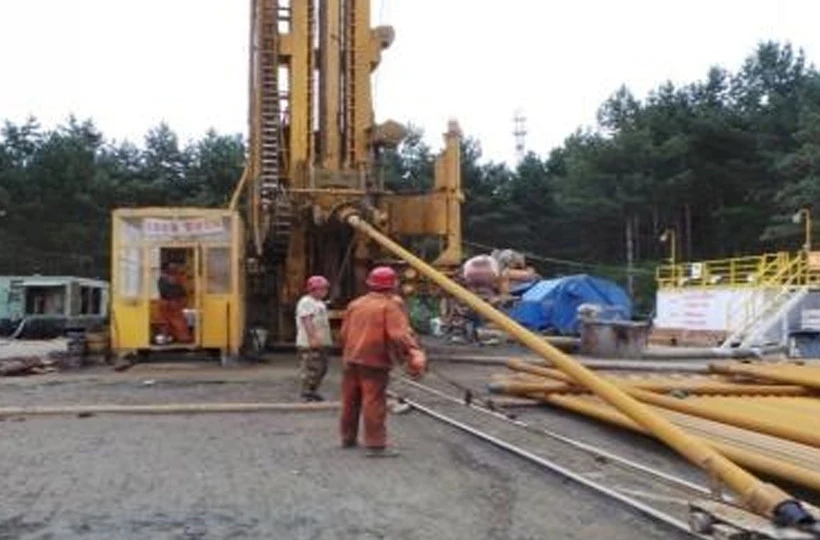
Around Fengman Reservoir in Jilin Province (northeast China), geothermal resources sit beneath some of the toughest drilled formations in the region: hard granite and basalt, with high rock hardness, strong abrasiveness, well-developed fractures and abundant fractured water. Conventional mud drilling performed poorly — extremely low penetration, severe bit and pipe wear, and frequent borehole wall collapse. Jinneng Drilling's technical team switched to a CMD-series full hydraulic rig fitted with heavy-duty DTH hammers and specialized heavy drillpipe, running a full-process pneumatic DTH positive-circulation drilling method. The result: a 2,004.42 m geothermal well with a 190 mm final hole, 387 hours of pure drilling time, and 5–10× higher drilling efficiency than the conventional mud process. The project supplies a proven, economic model for hard-rock geothermal exploration across northeast China.
Project Background & Challenge
The Fengman Reservoir area is geothermally promising — but the overburden and reservoir are hard rock, which is exactly where conventional drilling struggles:
- Hard, abrasive lithology: granite and basalt abrade bits and pipes fast, turning the cutting structure into a consumables problem.
- Fractured, water-bearing ground: well-developed fractures hold abundant fractured water, so mud circulation has trouble stabilizing the hole — wall collapse was frequent.
- Mud process bottleneck: with mud drilling, penetration was extremely low, wear severe, collapse frequent, schedule uncontrollable, and cost high.
The field team needed a fundamentally different rock-breaking and cuttings-removal method — not a faster version of the same mud approach.
Our Solution
The solution combined the right machine, the right downhole tool and the right fluid:
- CMD-series full hydraulic rig as the carrier (the CMD100-class multi-functional large-diameter rig family; exact model configuration: [TODO]), supplying the torque, rotation and air-handling capacity hard-rock DTH work demands.
- Heavy-duty DTH (down-the-hole) hammer: instead of shearing rock with bit rotation alone, the hammer delivers high-frequency percussion directly at the bit, breaking hard granite and basalt efficiently.
- Specialized heavy drillpipe: matched to the hammer's air flow and to the abrasive, fractured environment, reducing rod failure and wear.
- Full-process pneumatic DTH positive-circulation process: compressed air both drives the hammer and lifts cuttings out of the hole — efficient rock breaking at the bit and efficient cuttings removal up the annulus.
The air-based process also addressed the fractured-water and wall-stability problem that had plagued mud drilling.
Key Results
| Metric | Value |
|---|---|
| Final well depth | 2,004.42 m |
| Final hole diameter | 190 mm |
| Pure drilling time | 387 hours |
| Efficiency vs. conventional mud drilling | 5–10× higher |
| Formation | Hard granite and basalt; fractured, water-bearing |
| Drilling method | Pneumatic DTH hammer, positive circulation |
| Equipment | CMD-series full hydraulic rig + heavy-duty DTH hammer + heavy drillpipe |
| Well quality | Excellent |
For the full technical specifications of the CORTECH® CMD100, see the CMD100 product page.
Customer Value & ROI
- A step-change in penetration: the switch from mud to pneumatic DTH lifted drilling efficiency 5–10× in granite/basalt — the single biggest cost driver in hard-rock geothermal work.
- Less wear, less collapse: percussion breaking at the bit plus air cuttings removal reduced bit/pipe abrasion and cut the wall-collapse problems that had stalled the mud program.
- A deliverable 2,004 m well in controlled time: 387 hours of pure drilling, excellent well quality, and confirmation of considerable geothermal resource potential for the region.
- Repeatable regional template: the method gives northeast China's hard-rock geothermal exploration an efficient, economic and reliable blueprint.
FAQ
Why is mud drilling slow in granite and basalt?
Hard, abrasive crystalline rock shears poorly under rotational loading alone. Mud circulation also struggles to stabilize fractured, water-bearing intervals, so wall collapse and bit wear dominate — exactly the problems reported around Fengman Reservoir.
How does a DTH hammer speed up hard-rock drilling?
A down-the-hole hammer delivers high-frequency percussion directly at the bit, right where the rock breaks, instead of relying on surface torque to shear the rock. Compressed air simultaneously cleans the hole by lifting cuttings up the annulus.
What efficiency gain does air DTH give over mud drilling?
On this hard-rock geothermal well, drilling efficiency improved 5–10× versus the conventional mud process, with reduced tool wear and fewer wall-collapse incidents.
How deep was the Fengman hard-rock geothermal well?
The well reached 2,004.42 m with a 190 mm final hole, completed in 387 hours of pure drilling time using a CMD-series full hydraulic rig with pneumatic DTH hammer positive circulation.
Internal Links
- Rig product page
- Application hub
- Related case
- Related case
- Related case (cross-hub)
- FAQ knowledge base