

Large Diameter Rescue Shaft Drilling Rig: CMD100 711 mm Exercise with 660 mm Capsule
Executive Summary
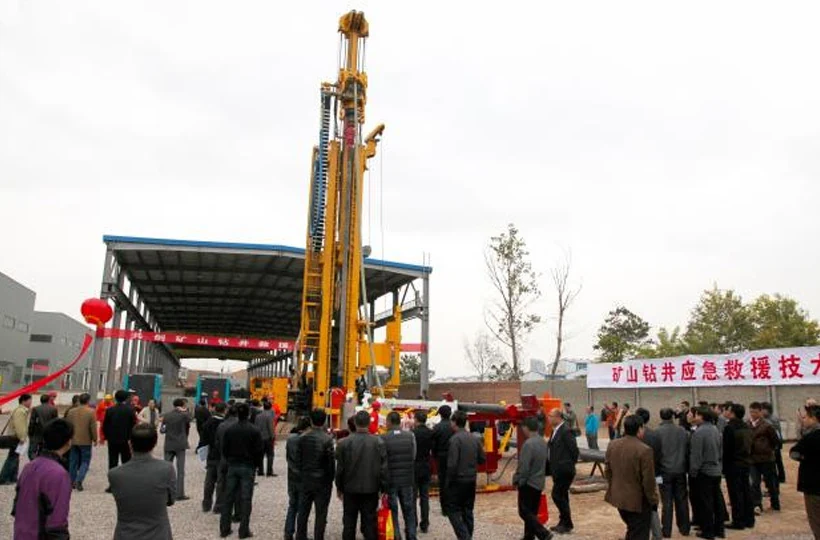
Mine rescue planning has long struggled with one gap: in roof-fall and collapse-prone ground, few rigs can simultaneously drill complex strata, open a large-diameter hole, lower a rescue capsule and deploy fast. To test whether domestic equipment could close that gap, a mine accident emergency rescue exercise — staged by the Special Exploration Center of China National Administration of Coal Geology, simulating a realistic roof-fall and collapse scenario — put the CORTECH® CMD100 rescue drilling rig through its paces. Fitted with a 711 mm large-diameter cluster DTH hammer and a pneumatic forward-circulation drilling process, the rig completed the large-diameter rescue borehole and successfully lowered a 660 mm rescue capsule, with zero equipment faults and no deviation throughout. The exercise met national mine rescue technical standards and became a benchmark for the domestic standardization of emergency rescue equipment.
Project Background & Challenge
The exercise was designed around a known real-world gap:
- Four demands at once: traditional equipment struggled to combine (1) drilling in complex strata, (2) completing a large-diameter hole, (3) lowering a rescue capsule, and (4) fast equipment deployment.
- Collapse-simulation ground: the site layout fully simulated a real mine collapse accident, including unstable ground conditions.
- Verification purpose: the exercise aimed to validate extreme working capability, running stability, construction safety and real adaptability, and to give national equipment selection an authoritative basis.
This was a controlled exercise to test equipment, not an actual incident response.
Our Solution
As a core technical support unit, the company supplied the CMD100 system:
- CMD100 full hydraulic truck-mounted rescue rig: rapidly deployable and stable under heavy drilling loads.
- 711 mm cluster DTH hammer: an array of hammers that together open a large-diameter hole efficiently in hard ground.
- Pneumatic forward-circulation process: air-driven forward circulation delivered clean, efficient large-diameter penetration.
- Capsule trial lowering: after the hole was completed, a 660 mm rescue capsule was lowered through the borehole to prove the full rescue path.
Key Results
| Metric | Value |
|---|---|
| Activity | Mine rescue exercise (simulated roof-fall / collapse) |
| Organizer | Special Exploration Center, China National Administration of Coal Geology |
| Rig | CORTECH® CMD100 truck-mounted rescue rig |
| Large-diameter tooling | 711 mm cluster DTH hammer |
| Drilling process | Pneumatic forward circulation |
| Rescue capsule lowered | 660 mm |
| Equipment reliability | Zero faults throughout; stable operation |
| Hole quality | Precise diameter; capsule lowered without deviation |
| Standards | Met national mine rescue technical standards |
For the full technical specifications of the CORTECH® CMD100, see the CMD100 product page.
Customer Value & ROI
- Proven large-diameter rescue path: the 711 mm hole-to-660 mm capsule sequence demonstrated that one rig can open and use a manned rescue passage.
- Zero-fault reliability: stable performance under simulated collapse conditions gave rescue planners confidence in domestic equipment.
- Standardization value: meeting national technical standards positions the rig as a repeatable, selectable component of national emergency preparedness.
- Lessons banked: the exercise accumulated practical experience and technical reference that improve future real rescue responses.
FAQ
How large a diameter rescue borehole can a rig drill?
In this exercise the CMD100 opened a 711 mm large-diameter rescue borehole using a cluster DTH hammer array — large enough to run a manned rescue capsule.
Can a rescue borehole lower a manned rescue capsule?
Yes. After completing the large-diameter hole, the exercise successfully lowered a 660 mm rescue capsule through it with no deviation, proving the full rescue path.
What is cluster DTH hammer drilling for large shafts?
A cluster of down-the-hole hammers mounted together cuts a much larger diameter than a single bit, enabling efficient large-diameter hole opening in hard rock — here the 711 mm cluster hammer on the CMD100.
How is a mine rescue equipment exercise conducted?
It simulates a real roof-fall or collapse scenario, follows actual rescue operating standards, and measures reliability, hole precision and capsule handling — as this exercise did, with zero faults and national-standard results.
Internal Links
- Rig product page
- Application hub
- Related case
- Related case
- Related case
- FAQ knowledge base