

Uranium Exploration Drilling Rig Desert Plateau: CMR1000A in Kashi, Xinjiang, China
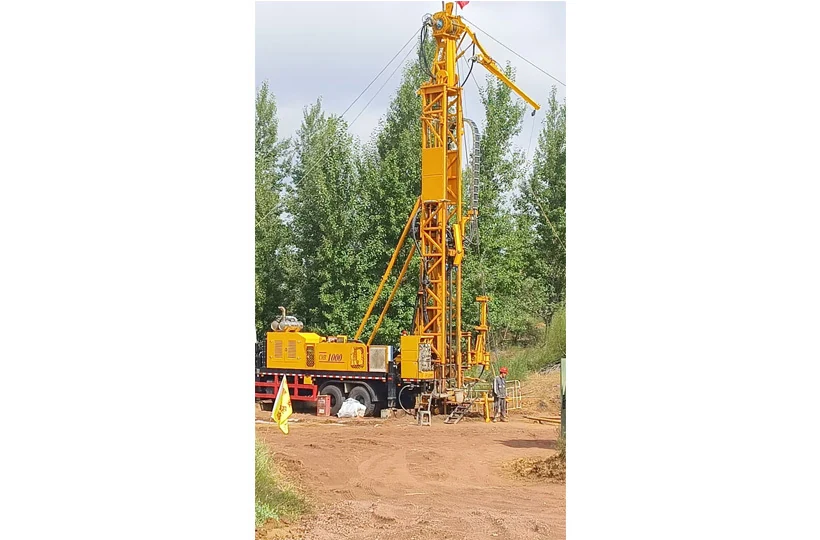
Executive Summary
The Kashi (Kashgar) region of Xinjiang holds significant uranium potential, but the work site sits on a high-altitude arid desert plateau with extreme day-night temperature swings (down to around −30 °C range), severely fractured strata and frequent sandstorms. Conventional single-process rigs adapt poorly here, suffer high failure rates and cannot hold a stable production schedule. The solution was the CORTECH® CMR1000A multi-functional combination drilling rig — fitted with a plateau-rated engine, reinforced chassis and combined drilling tools that switch between diamond wireline coring, air reverse circulation (RC) sampling and tricone/air drilling on a single machine. During the program the rig completed 28 exploration holes, with a deepest hole of 850 m, achieving excellent core quality and accurately defining the uranium distribution and reserves.
Project Background & Challenge
Uranium exploration in the Kashi desert plateau is defined by a combination of hostile environment and unpredictable ground:
- Extreme climate: high altitude, arid desert, very large day-night temperature difference and a −30 °C-range cold exposure push engines, hydraulics and crews to their limits.
- Sandstorms: frequent dust and wind threaten cooling, seals and drilling-fluid quality.
- Fractured, variable strata: the ground is heavily fractured and changes character from hole to hole — conditions that cause borehole collapse, tool sticking and loss of circulation if only one drilling method is used.
- Many holes, one budget: a 28-hole campaign cannot afford to mobilize a different rig for every lithology, so the drill must change method, not machine.
Our Solution
The project deployed the CORTECH® CMR1000A, a top-drive hydraulic combination rig engineered to run multiple drilling crafts on a single chassis. The features that solved the desert-plateau brief:
- Plateau-rated power plant: a Cummins L8.9CS4 330C turbocharged engine delivering 242 kW at 2,200 rpm, paired with a 29 MPa heavy-duty air-cooled hydraulic system, sustains output in thin, cold, dusty air.
- Multi-process drilling on one rig: the CMR1000A integrates diamond wireline coring (up to 3,000 m B-size), air reverse circulation sampling (400 m on 4″ rods, 320 m on 4.5″ rods) and tricone rotary drilling. Operators switch instantly between fluid, mud and air-driven methods, eliminating collapse and sticking in fractured ground.
- Uncontaminated RC samples: isolated dual-wall air RC lifts chips directly to surface, bypassing the borehole wall, so uranium assays are not cross-contaminated.
- Reinforced chassis and 250 kN pullback: the heavy 24.5-ton platform and reinforced base stand up to sandstorms and uneven pads, while 250 kN lifting / 110 kN feed handles long coring strings.
- Flexible rod compatibility: foot clamps accept B, N, H, P, PW rods and break out 3.5″, 4″ and 4.5″ rods, matching the process to the formation on every hole.
Key Results
| Metric | Value |
|---|---|
| Location | Kashi (Kashgar), Xinjiang, China |
| Environment | High-altitude arid desert plateau, sandstorms, fractured strata |
| Temperature range | Around −30 °C range (extreme day-night swing) |
| Commodity | Uranium |
| Exploration holes completed | 28 |
| Deepest hole | 850 m |
| Rig | CORTECH CMR1000A multi-process combination rig |
| Drilling methods | Diamond wireline coring + air reverse circulation + tricone/air drilling |
| Core/sample quality | Excellent; accurate uranium distribution and reserve definition |
For the full technical specifications of the CORTECH® CMR1000A, see the CMR1000A product page.
Customer Value & ROI
- One rig, every lithology: switching between coring, RC and air drilling on a single machine avoided mobilizing multiple rigs across 28 scattered desert-plateau holes.
- Better data, fewer re-holes: uncontaminated RC chips plus intact wireline core gave accurate uranium distribution and reserve figures, reducing the risk of under- or over-estimating the deposit.
- Survived the climate: plateau-rated turbocharged engine and air-cooled 29 MPa hydraulics kept the rig running through −30 °C-range cold and sandstorms, minimizing the failure rates that plagued conventional rigs.
- Strategic support: the program delivered the reliable data needed for Xinjiang's uranium exploration development.
FAQ
What is a multi-functional combination drilling rig?
It is a single rig that runs several drilling methods without changing machines. The CMR1000A combines diamond wireline coring, air reverse circulation (RC) sampling and tricone rotary/air drilling, letting operators match the method to the formation as geology changes.
How does reverse circulation differ from diamond coring?
Diamond wireline coring recovers a solid, continuous core for detailed lithology and structure. Air reverse circulation lifts cuttings through a dual-wall pipe to surface, giving rapid, uncontaminated chip samples for assay. Using both on one rig gives speed and sample integrity in variable ground.
How many holes did the CMR1000A complete in Kashi?
The CMR1000A completed 28 uranium exploration holes in the Kashi desert-plateau program, with a deepest hole of 850 m, using coring, reverse circulation and air drilling as the strata required.
Can one rig do coring, reverse circulation and air drilling?
Yes. That is the design purpose of the CMR1000A: a plateau-rated 242 kW engine, 29 MPa air-cooled hydraulics and combined drilling tools let it switch between coring, RC and air-driven methods on the same chassis — a major advantage where fractured desert strata change from hole to hole.
Internal Links
- Rig product page
- Application hub
- Related case
- Related case
- Related case
- FAQ knowledge base