

Mine Ventilation Shaft Drilling Rig Reaming: CMD100 Builds a Staged-Reamed Shaft in 26 Days
Executive Summary
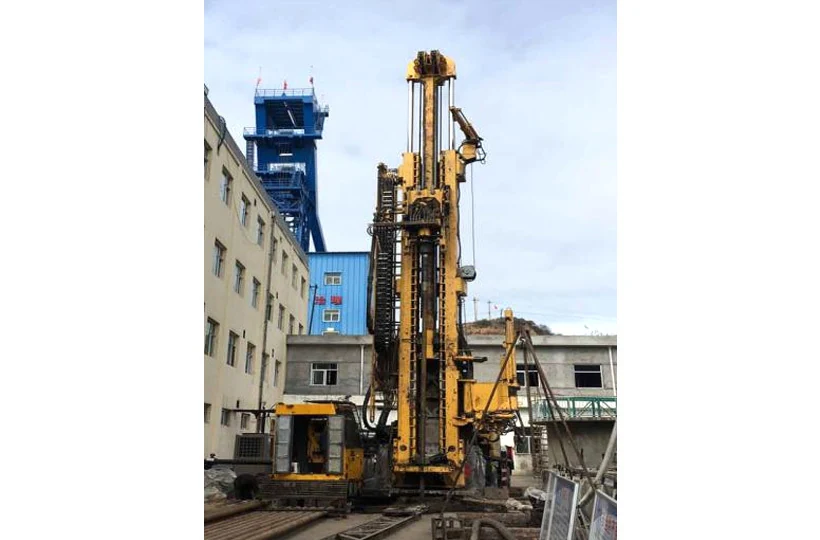
A large underground mine in Qinyuan County, Shanxi Province, suffered poor baseline ventilation and persistently high gas concentrations, creating a long-standing safety exposure. The ground was especially difficult — soft and hard layers alternating frequently, with local fault zones prone to wall collapse and air leakage. Rather than drill straight to full diameter, our technical team deployed the CORTECH® CMD100 full-hydraulic truck-mounted rig using a pilot-hole plus staged reaming method. A Φ216 mm pilot hole of 254 m was drilled in just 2 days to confirm the strata, after which raise-boring reaming enlarged the bore through Φ470 mm to a finished Φ710 mm at an average 3–5 m/h. The complete ventilation shaft was handed over in 26 days, with a stable wall and ventilation performance meeting mine safety standards; the project has since become the local reference for ventilation-shaft construction.
Project Background & Challenge
The mine's daily operating environment was deteriorating:
- Poor ventilation, high gas: inadequate airflow allowed gas to accumulate, a chronic hazard that demanded a new deep, large-diameter ventilation shaft.
- Interbedded, faulted ground: strata alternated between soft and hard, and local fault zones risked borehole-wall collapse and air leakage.
- Stringent rig demands: the conditions placed heavy demands on torque, hoisting capacity, machine stability and process adaptability — all beyond what ordinary low-efficiency rigs could deliver without frequent accidents and lost schedule.
Our Solution
The team engineered a pilot-plus-reaming sequence around the CMD100:
- Step 1 — pilot hole: a Φ216 mm pilot was drilled to 254 m in 2 days, rapidly revealing formation conditions before any large-diameter reaming began.
- Step 2 — staged raise reaming: using a raise-boring (reverse reaming) method, bits of Φ470 mm and then Φ710 mm enlarged the bore progressively to design diameter.
- Wall-stability controls: targeted stabilization measures during reaming prevented collapse in the soft and faulted intervals and preserved the finished wall.
- Rig capability behind the method: the CMD100's 100 t (1,000 kN) pullback, 27,500 Nm low-speed top-drive torque and 559 kW Cummins engine provided the pull and torque needed to pull reaming tools through interbedded ground; its 2.08 m BOP-ready worktable and 6-point outrigger layout kept the rig stable on uneven ground.
Key Results
| Metric | Value |
|---|---|
| Pilot hole | Φ216 mm, 254 m |
| Pilot duration | 2 days |
| Reaming sequence | Φ470 mm → Φ710 mm (raise reaming) |
| Reaming penetration | Avg. 3–5 m/h |
| Total project duration | 26 days |
| Finished wall | Stable, gauge, no collapse |
| Ventilation result | Met mine safety standards |
For the full technical specifications of the CORTECH® CMD100, see the CMD100 product page.
Customer Value & ROI
- Gas risk reduced fast: a 26-day build meant the mine's ventilation deficit and gas-accumulation exposure were closed down quickly, rather than dragging on through a slow conventional project.
- Lower accident cost: the pilot-first approach de-risked the unknown fault zones before committing full-diameter tools, and wall-stabilization controls avoided the collapse and stuck-pipe incidents that had plagued earlier attempts.
- Measurable reaming rate: consistent 3–5 m/h reaming gave the mine a predictable schedule and cost basis, not a best-guess estimate.
- Transferable method: as a recognized local demonstration project, the pilot-plus-staged-reaming workflow is now a proven reference for similar shafts.
FAQ
What is pilot hole plus staged reaming for a ventilation shaft?
A small pilot hole is drilled first (here Φ216 mm to 254 m in 2 days) to confirm the strata, then the bore is enlarged in steps by reverse/raise reaming (Φ470 mm, then Φ710 mm). It is safer and faster than drilling full diameter through uncertain, faulted ground.
How fast can a reaming rig enlarge a ventilation shaft?
On this project the CMD100 reamed at an average of 3–5 m/h from Φ470 mm up to the finished Φ710 mm, and the entire shaft — pilot plus reaming — was completed in 26 days.
Which rig handles soft-hard alternating strata and fault zones?
A full-hydraulic, high-torque truck rig like the CMD100 (100 t pullback, 27,500 Nm top-drive torque, six-point outriggers) maintains the pull, torque and stability needed to pull reaming tools through interbedded and faulted ground without collapse.
How long does a 250 m deep ventilation shaft take to ream?
The 254 m-deep pilot was finished in 2 days, and the full Φ710 mm shaft including reaming and wall stabilization was handed over in 26 days total.
Internal Links
- Rig product page
- Application hub
- Related case
- Related case
- Related case
- FAQ knowledge base