

Beating the Heat: How Advanced Thermal Management Prevents Failure in Full Hydraulic Core Drilling Rigs
In deep-hole exploration drilling, your equipment is constantly fighting against two major forces: geological resistance and internal thermal energy. While fluid power provides the immense torque and crowd force required to penetrate hard strata, it has one major vulnerability—heat.
During continuous, full-load operations, a full hydraulic core drilling rig can generate 8 to 15 kW of waste heat. Without a highly efficient thermal management system, this energy accumulates rapidly, leading to a phenomenon engineers dread: hydraulic thermal runaway.Let's look at how hydraulic overheating destroys drilling productivity and how modern engineering can eliminate this risk.
The Cost of Overheating: How Excessive Temperature Kills Your Drill Rig
When a hydraulic system runs too hot (typically exceeding 65°C to 70°C), it triggers a destructive chain reaction across the entire machine:1.Fluid Thinning & Power Loss: As hydraulic oil temperatures spike, the fluid’s viscosity drops significantly. This thinning reduces the volumetric efficiency of your pumps and motors. Operators will notice the rig becoming sluggish, with dropping system pressure and an inability to maintain constant torque.
2.Accelerated Seal Failure: High-pressure hydraulic seals and O-rings are the unsung heroes of your rig. Extreme heat accelerates their aging process, causing the rubber compounds to harden, crack, or even melt. Once a seal fails, high-pressure oil leaks follow, risking environmental contamination and catastrophic component damage.
3.Premature Component Wear: Thin oil loses its film strength. Metal-on-metal contact increases inside expensive hydraulic pumps and valves, leading to abrasive wear and premature component scuffing.
In remote mining sectors, a blown seal or a failing main pump caused by overheating doesn't just mean a few hours of downtime—it means waiting days for replacement parts to arrive at a remote exploration site.
Standard Cooling vs. The CSD Series Independent Radiator Solution
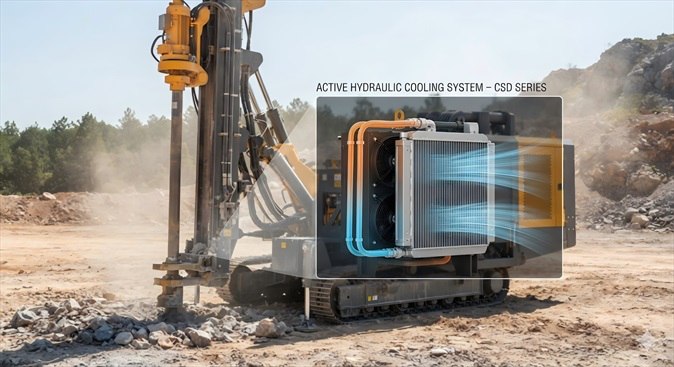
Many conventional drilling rigs route hydraulic return lines through a basic inline cooler integrated with the engine radiator. While cheaper to manufacture, this setup fails during peak summer operations or prolonged high-load drilling in complex formations.To solve this, our CSD1300 and CSD1800 series full hydraulic core drilling rigs utilize a dedicated, independent radiator unit. This active thermal management system isolates the hydraulic cooling process, delivering massive reliability advantages:
[Conventional Design] --> Shared Engine Radiator --> High Risk of Overheating under Peak Load
[CSD 1300/1800 Design] --> Dedicated Independent Radiator Unit --> Stable Active Cooling & Uniform Temp Control
1. Active & Dedicated Thermal Control
Unlike passive or shared systems, the independent cooling unit on the CSD series operates on its own dedicated loop. It actively monitors fluid temperatures and forces high-volume airflow across the cooling cores, ensuring that waste heat (up to 15 kW) is continuously and effectively dissipated.2. Uniform Temperature Stability
By keeping the hydraulic fluid within its optimal viscosity window (typically 40°C–55°C), the CSD1300 and CSD1800 series maintain rock-solid pressure stability. Even during hot summer operations or when drilling through demanding, highly abrasive formations, your rig delivers 100% of its rated torque and pulling force.3. Maximized Lifespan of Seals and Components
Lower fluid temperatures mean your premium, imported hydraulic components and high-pressure seals operate within their designed environment. This drastically reduces seal hardening and eliminates internal fluid friction wear, lowering your total cost of ownership (TCO).Field-Proven Reliability: Built for the Touhest Exploration Shifts
When your project timeline depends on running double shifts in challenging climates, you cannot afford a machine that needs to rest to "cool down."By choosing a full hydraulic core drilling rig equipped with an independent radiator unit—like the CSD1300 or CSD1800—you protect your investment from the inside out. You gain a machine engineered to deliver consistent, uninterrupted penetration rates, no matter how harsh the environment.