

Hard Rock Challenge: How Full Hydraulic Control Minimizes Drill Bit Wear and Tripping Downtime
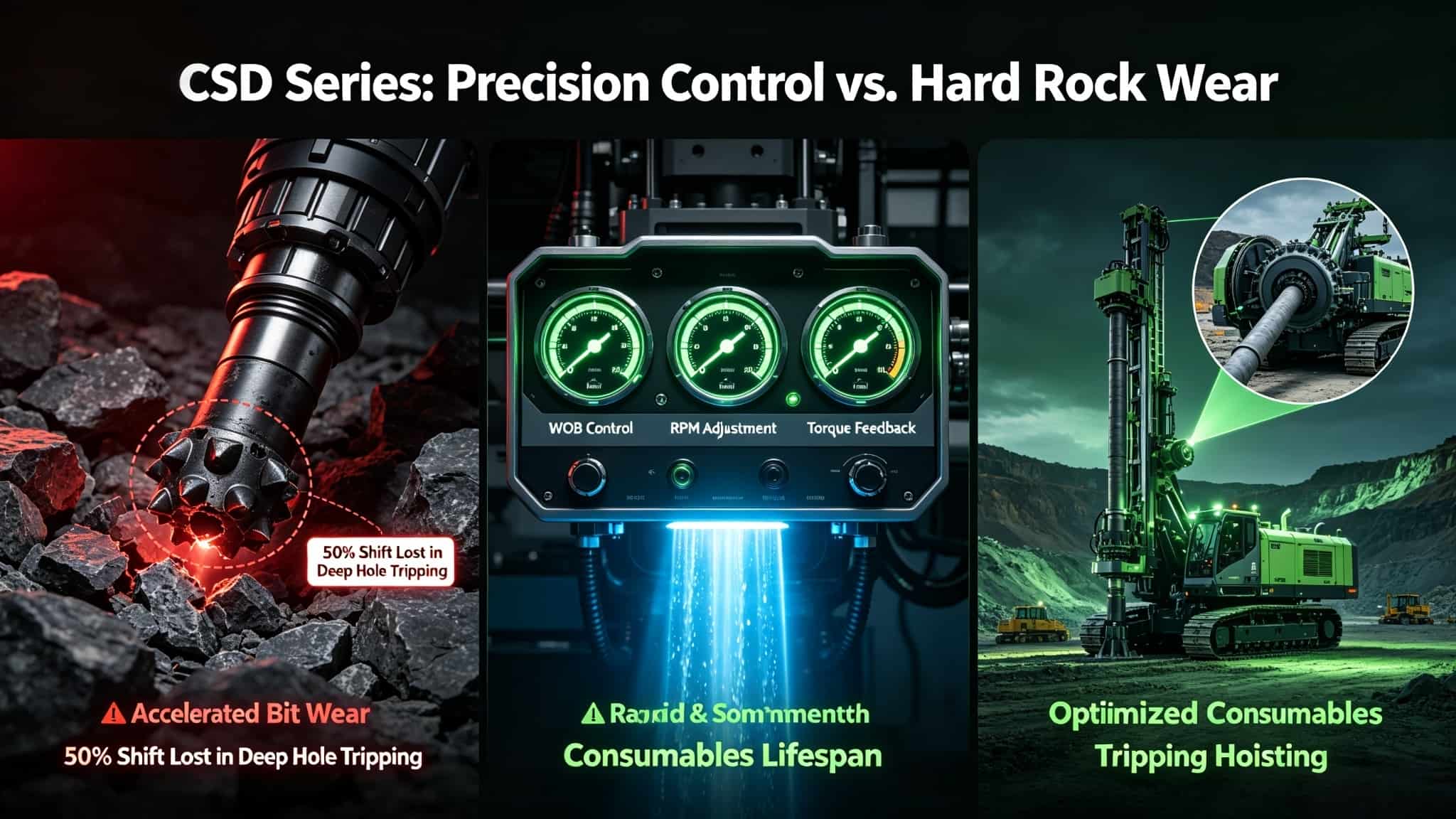
In deep mineral exploration, geological hardness is the ultimate benchmark of efficiency. When drilling through ultra-hard formations like basalt, quartzite, or granite, the wear rate of your frontline consumables—specifically diamond core bits and impregnated bits—can make or break your project’s profitability.
Every driller knows the agony of deep hole tripping. When a bit wears out at a depth of 800 or 1,000 meters, the entire operation grinds to a halt. The crew must pull out, unthread, change, and re-lower hundreds of heavy drill rods, a grueling process that can drain up to 50% of a shift's working hours.
To maximize profitability, you need a full hydraulic core drilling rig that does two things perfectly: prevents premature bit wear through precise parameters matching, and slashes the time spent on unavoidable tripping.
The Root Cause of Premature Bit Wear: Blind Feeding
In hard and variable strata, standard mechanical or poorly modulated rigs often suffer from "blind feeding"—applying excessive, unmonitored force to force penetration. This lack of control leads to major issues:- Cutter Chipping & Glazing: Too much weight-on-bit (WOB) cracks the diamond matrix, while insufficient pressure causes the bit to slip and "glaze" over, losing its cutting edge.
- Overheating & Thermal Cracking: Inconsistent rotation speed generates intense friction, heating the cutters to critical failure temperatures.
- Vibration Fatigue: Sudden transitions between soft and hard layers create destructive impact loads, accelerating both bit wear and drill rod thread fatigue.
The CSD Approach: Maximizing Consumable Lifespan Through Fluid Precision
Our CSD1300 and CSD1800 series full hydraulic core drilling rigs change the dynamics of hard-rock drilling. By giving operators continuous control over cutting parameters, these rigs protect your downhole tools from the inside out.1. Surgical Precision Over WOB, Speed, and Torque
The CSD series features highly responsive fluid controls that allow drillers to infinitely modulate the weight-on-bit, rotation speed, and rotational torque. Instead of guessing, operators can match the cutting parameters perfectly to the rock's hardness. This precision eliminates bit slippage and premature wear, ensuring the diamond matrix self-sharpens efficiently.2. Vibration Stabilization in Interbedded Layers
When transitioning through fractured zones or interbedded (soft-and-hard layered) formations, the CSD’s advanced hydraulic circuit dampens sudden shocks. By stabilizing the rotation and maintaining smooth downward feed, the rig reduces high-impact loads on the bit teeth, preventing costly cutter chipping.3. High-Efficiency Hydraulic Winch and Rapid Tripping
When a bit swap is finally required, the CSD1300 and CSD1800 maximize your speed on the surface. Equipped with heavy-duty hydraulic main winches and high-speed synchronized hoisting systems, the rigs streamline the rod-handling cycle.Combined with rapid-acting hydraulic foot clamps and smooth mast rotation controls, the crew can break and trip out hundreds of meters of drill strings with minimal friction and physical strain, turning an all-day chore into a fast, routine transition.
Strategic Guide: Quick On-Site Diagnostics for Diamond Bits
| Symptoms & Engineering Analysis | CSD System Corrective Actions |
|---|---|
| DIAMOND BIT FIELD DIAGNOSTICS & SYSTEM CORRECTIONS | |
|
Bit Glazing / Polishing Primary Cause: Insufficient WOB relative to rock hardness. |
Increase hydraulic feed pressure slightly; lower RPM to let diamonds bite efficiently into hard strata. |
|
Premature Cutter Chipping Primary Cause: High vibration or excessive sudden impact. |
Engage the integrated hydraulic dampening feed circuit; stabilize variable rotation speed to mitigate impact loads. |
|
Overheated / Burned Bit Primary Cause: Inadequate flushing or excessive rotational speed. |
Optimize mud pump fluid delivery parameters; step down spindle RPM via the variable hydraulic control valve. |