

Optimizing Large Diameter Drilling: How to Solve Slurry Management and Cutting Removal Challenges
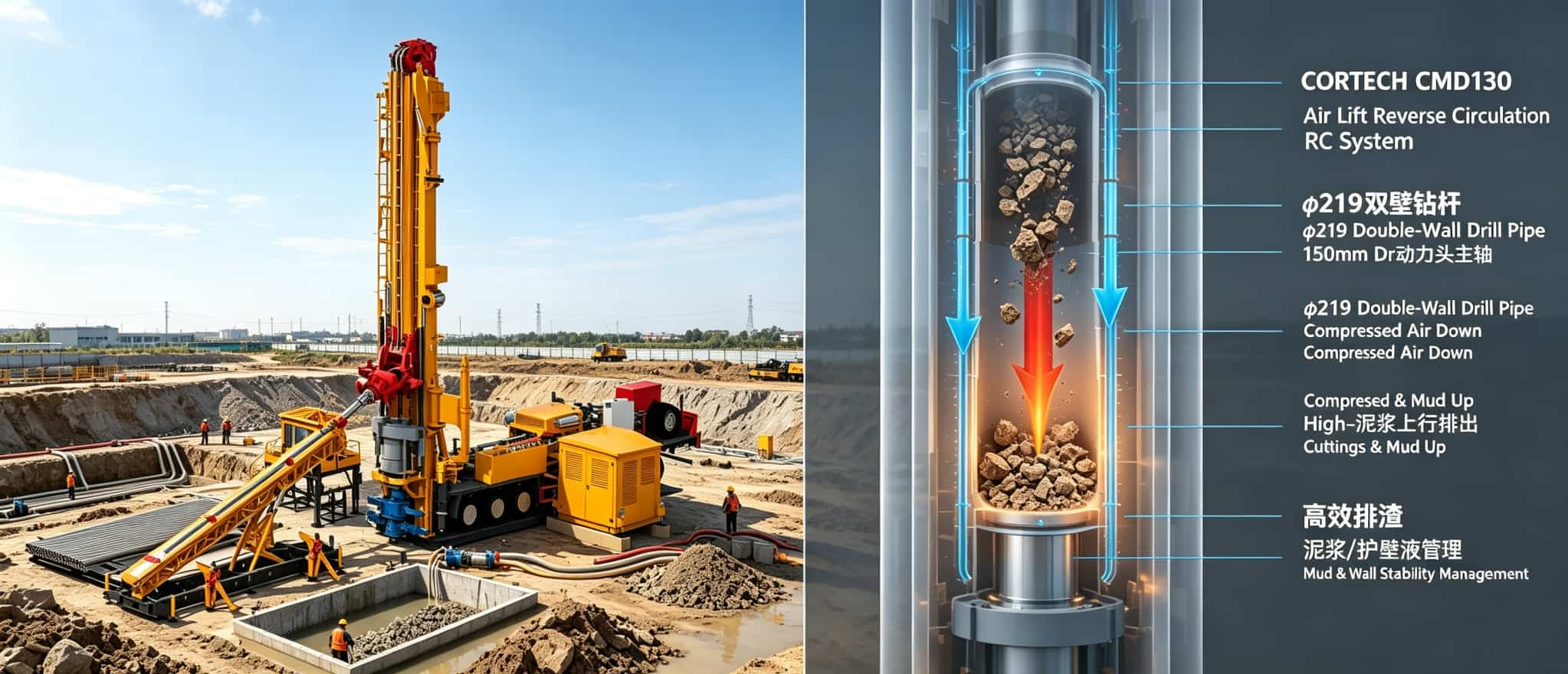
In heavy foundation engineering, deep borehole drilling, and mine rescue operations, choosing the right large diameter drilling rig (Rotary Drilling Rig) is critical. However, as the borehole diameter expands, engineering challenges do not increase linearly—they grow exponentially.
Geotechnical contractors consistently face four core operational hurdles: slurry and fluid management, drill bit wear and hard-rock welding repairs, borehole collapse in loose formations, and precise torque-to-pulldown distribution. Among these, cutting removal efficiency and slurry costs represent the primary financial and operational bottlenecks in the field.
The Core Bottlenecks of Large-Diameter Drilling Operations
1.Cutting Accumulation and Regrinding: Due to the massive cross-sectional area of a large borehole, the volume of displaced earth and rock chips increases geometrically. If the flushing fluid flow rate is insufficient or the lifting velocity is too slow, cuttings rapidly accumulate at the bottom of the hole. This forces the drill bit to continuously regrind old debris, accelerating cutter wear, reducing the Rate of Penetration (ROP), and significantly increasing the risk of stuck pipe incidents.2.The Slurry Management Dilemma: Traditional direct circulation drilling requires vast volumes of high-viscosity drilling mud (such as bentonite) and high-powered trash pumps. Operators face a difficult trade-off: thicker slurry excels at suspending large cuttings but strains the pumping equipment and increases the risk of hydraulic binding. Conversely, thinner slurry reduces equipment wear but fails to lift heavy rock fragments, leading to borehole instability and eventual wall collapse.
To break this operational bottleneck, advanced geotechnical projects are rapidly transitioning to Air Reverse Circulation (RC) drilling technology. However, executing air reverse circulation effectively demands a drilling rig engineered with an exceptionally large top-drive spindle clearance.
The CORTECH® CMD130 Series: Engineered for High-Efficiency Air Reverse Circulation
To address cutting clearance issues and high mud costs, the CORTECH® CMD130 Series introduces an engineering solution. Every configuration within the CMD130 family features an integrated 150mm main spindle inner diameter, allowing seamless compatibility with φ219 dual-wall drill rods.By injecting high-pressure compressed air down the outer annulus of the dual-wall string, a powerful vacuum effect is created at the bit face. This forces the slurry, water, and large rock cuttings directly up through the center of the 150mm inner channel, bypassing the borehole annulus entirely.
The CMD130 platform offers three application-specific models to match localized site constraints:
1. CMD130DL Crawler-Mounted (Electric-Powered) Drilling Rig
Designed for green mining operations, zero-emission urban zones, and long-term projects with reliable access to a power grid.- Key Specifications: Driven by a high-efficiency 400kW electric motor with advanced electro-hydraulic controls. The feed system delivers 130 tons of hoisting capacity and 26 tons of pulldown force, paired with a maximum top-drive torque of 35,000 N·m.
- Field Application: The electric-drive configuration minimizes hourly operating costs. The 35,000 N·m torque output ensures steady penetration through hard rock strata without thermal degradation, while the wireless remote-controlled crawler tracks allow safe, precise positioning on tightly constrained urban jobsites.
2. CMD130L Crawler-Mounted (Diesel-Powered) Drilling Rig
Engineered for remote exploration, rapid-response emergency mine rescue, and deep geothermal drilling where grid infrastructure is unavailable.- Field Application: Mounted on a heavy-duty, high-traction crawler chassis, the CMD130L handles steep terrain and soft, uncompacted soils. It combines the robust field mobility of a diesel engine with the heavy structural feed and torque capacity of the CMD130 line, ensuring reliable operations in remote territories.
3. CMD130 Truck-Mounted Drilling Rig
The definitive solution for high-frequency regional mobilization and urgent emergency deployment.- Key Specifications: Built on a heavy-duty 10 X 8 drive truck chassis and powered by a premium Chongqing Cummins QSK19-C760 engine (567kW @ 2100rpm). It maintains the series-standard 130-ton hoist capacity, 26-ton pulldown capacity, and a robust 31,000 N·m of torque. The telescoping structural mast reaches 21.2 meters when fully extended (13.6m retracted) with a working feed stroke of 15.2 meters. The entire rig weighs 60 tons (54.5 tons in transport-licensed state).
- Field Application: The truck-mounted architecture eliminates the need for modular teardown and multi-trailer freight. It arrives on site fully assembled and ready to rig up, making it the industry standard for emergency mine rescue and fast-turnaround civil works.