

Mine Dewatering Borehole Drilling Rig: A Φ1100→Φ900→Φ650 mm Diameter Program
Executive Summary
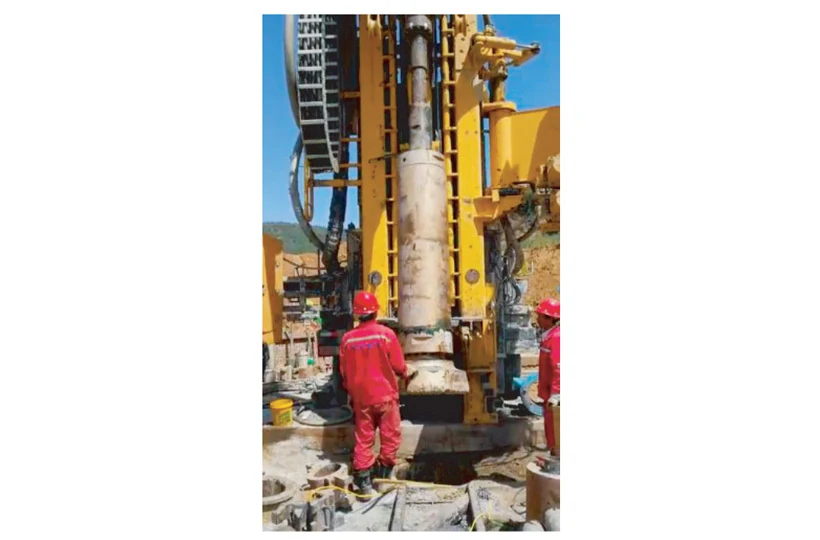
For dewatering wells, the surface section must be oversized and cased to take high flows and unstable ground, while the deeper section is stepped down to a workable drilling diameter. The CORTECH® CMD100 truck-mounted large-diameter rig executed exactly this kind of diameter program for a mine dewatering borehole: a Φ1100 mm first opening with surface casing, a Φ900 mm DTH second opening drilled to 13 m, a diameter reduction to Φ650 mm at 7 m, and then continued DTH drilling down to a final depth of 253 m. This article explains the step-by-step program, why each diameter is chosen, and the rig capability that makes a large-aperture dewatering borehole drillable.
The Diameter Program, Step by Step
A dewatering borehole is not drilled at one fixed diameter from top to bottom. The CMD100 sequence was:
- First opening — Φ1100 mm: the mouth was opened at a large 1100 mm diameter and surface casing was run immediately. The oversized surface section and casing secure the unconsolidated near-surface ground and provide a large clear throat for high-volume drainage.
- Second opening — Φ900 mm DTH: a Φ900 mm DTH (down-the-hole) hammer drilled the second section down to 13 m, establishing the main bore below the casing shoe.
- Diameter reduction at 7 m: at 7 m depth the hole was reduced from Φ900 mm to Φ650 mm, stepping the bore down to the productive hole size.
- Deep section — Φ650 mm to 253 m: the reduced Φ650 mm bore was then drilled onward to the final depth of 253 m.
Key Results
| Metric | Value |
|---|---|
| First opening | Φ1100 mm (surface casing run) |
| Second opening | Φ900 mm DTH, to 13 m |
| Diameter reduction | Φ900 mm → Φ650 mm at 7 m |
| Final (productive) diameter | Φ650 mm |
| Final depth | 253 m |
| Rig | CORTECH CMD100 truck-mounted |
| Method | Staged large-aperture program, DTH hammers |
For the full technical specifications of the CORTECH® CMD100, see the CMD100 product page.
Customer Value & ROI
- Large throat, high flow: the Φ1100 mm cased surface section and stepped bore give the dewatering well a generous flow path — the practical requirement for pumping large volumes of mine water.
- Stability from day one: running surface casing on the first opening secures the near-surface ground, so the high-flow well stays open over its service life.
- Efficient deep section: reducing to Φ650 mm at 7 m concentrates drilling effort where it matters, reaching 253 m without wasting power on an oversized deep hole.
- Repeatable template: this staged Φ1100→Φ900→Φ650 program is a directly reusable design for other large-aperture dewatering and drainage boreholes.
FAQ
How is a large dewatering borehole diameter program designed?
It starts with an oversized, cased surface opening (here Φ1100 mm), drills a large DTH second section (Φ900 mm), reduces to a productive diameter (Φ650 mm), and continues that diameter to total depth (253 m) — balancing flow area near the surface with efficient deep drilling.
Why run surface casing on a dewatering well?
Surface casing on the Φ1100 mm first opening secures unconsolidated near-surface ground and provides a clean, large throat for high-volume water removal, preventing the well from collapsing or leaking at the most exposed section.
When do you reduce diameter during well drilling?
After the large DTH second section establishes the bore below the casing. Here the hole was reduced from Φ900 mm to Φ650 mm at 7 m, then continued at Φ650 mm to 253 m.
How deep can a CMD100 dewatering borehole go?
In this program the CMD100 drilled the productive Φ650 mm section to a final depth of 253 m, backed by 100 t (1,000 kN) pullback and a 559 kW / 27,500 Nm top drive.